
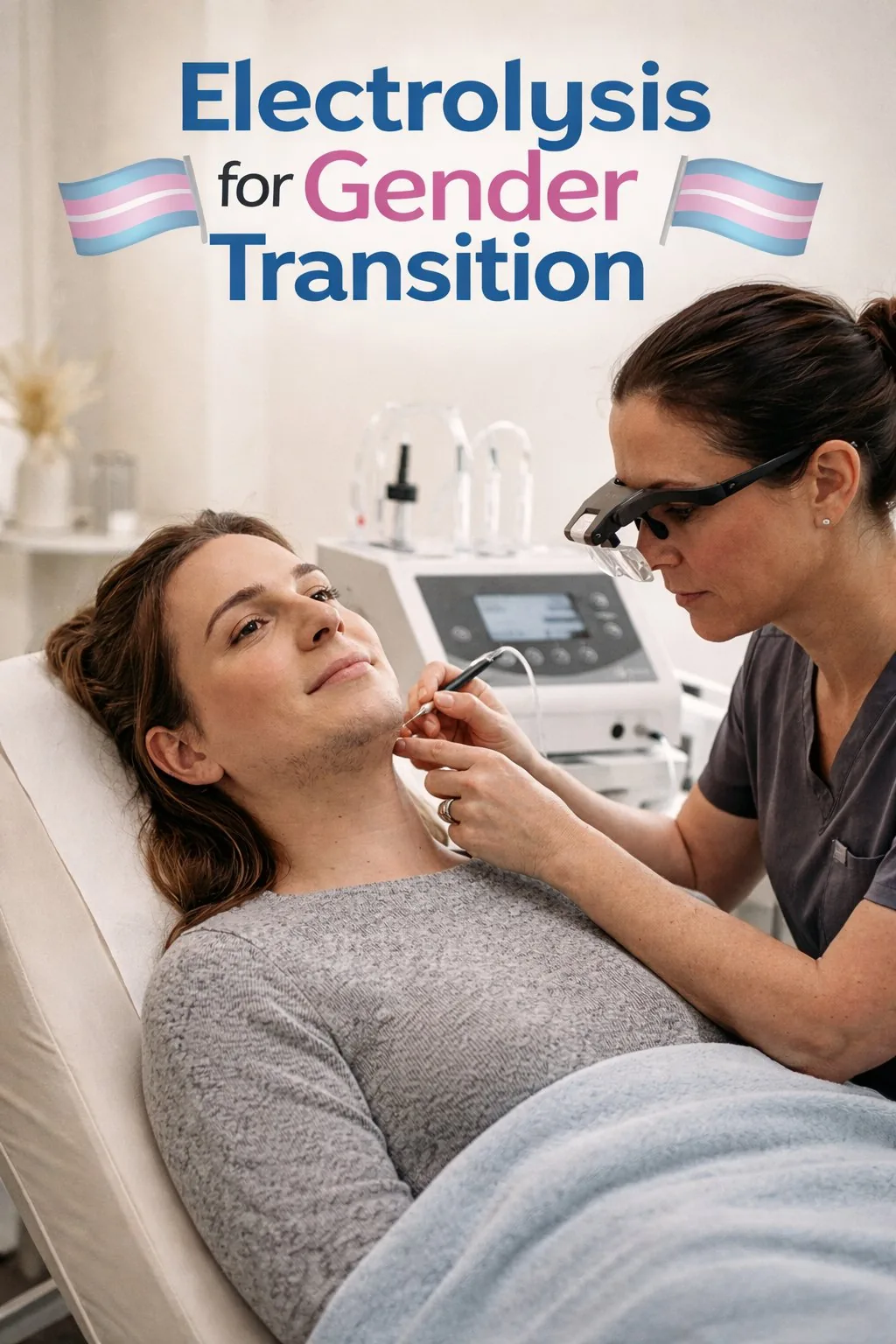
At MVP Electrolysis, we believe hair removal isn’t just cosmetic – it’s personal. For many people in transition, unwanted hair is one of the most frustrating and emotionally charged parts of the process. The good news: there is a permanent solution. Permanent hair removal during gender transition by electrolysis.
Electrolysis is the only FDA-recognized method for permanent hair removal, and it can play a powerful role in helping you feel more at home in your skin.
Why Hair Removal Matters During Transition
This isn’t a vanity issue – the research is clear.
A 2019 University of Minnesota study of 281 transfeminine adults found that satisfaction with hair removal was directly linked to lower rates of depression, anxiety, and body image dysphoria and higher positive affect. The authors specifically challenged the framing of hair removal as “cosmetic,” noting its meaningful psychological impact.
A 2021 study published in JAMA Dermatology, drawing on data from over 27,000 transgender adults, reinforced those findings: gender-affirming hair removal was associated with lower odds of severe psychological distress and suicidal ideation.
In short, getting hair under control can meaningfully improve day-to-day mental health, not just appearance.
What Makes Electrolysis Different from Laser
Both electrolysis and laser hair removal are popular options, but they work differently and they’re regulated differently by the FDA.
Laser Hair Removal
Laser is FDA-cleared for permanent hair reduction, meaning it can significantly decrease hair growth long-term. However, it relies on melanin in the hair shaft to work. That makes it less effective (or completely ineffective) on blonde, gray, red, and white hair, and it carries a higher risk of hyperpigmentation on darker skin tones.
Electrolysis
Electrolysis works by inserting a fine probe into each individual follicle and delivering a small electrical current directly to the growth center, permanently destroying it. Because it doesn’t depend on pigment, it works on all hair colors and all skin tones. The FDA recognizes electrolysis as the only method achieving permanent hair removal (not just reduction), a distinction the American Electrology Association has confirmed directly with the FDA’s Center for Devices and Radiological Health.
The trade-off is time: electrolysis treats follicles one at a time, making it more session-intensive than laser. For many clients in transition, it’s not either/or the two methods can complement each other depending on treatment area, hair color, and skin tone.
The Three Types of Electrolysis
- Thermolysis – uses heat to permanently destroy the follicle
- Galvanic – uses a chemical reaction created by direct electrical current
- Blend – combines both methods; particularly effective for stubborn or curved follicles
For Transfeminine Clients: Clearing Facial Hair for Good
Facial hair is often the most emotionally significant treatment area.
Even with a close shave and full-coverage makeup, beard shadow can persist and it can be a significant daily source of dysphoria. Electrolysis addresses the problem at the follicle level, not just the surface.
Electrolysis helps:
- Eliminate beard shadow permanently at the source
- Improve skin texture and smoothness over time
- Reduce reliance on heavy coverage makeup
Because it targets each follicle individually, it can be used across the full face, neck, and surrounding areas—regardless of hair color.
For Transmasculine Clients: Precision and Control
Electrolysis isn’t only about removing everything – it’s also about control.
Transmasculine clients may be looking for:
- Cleanup of specific areas for comfort or aesthetics
- Surgical site preparation (e.g., forearm or thigh donor sites for phalloplasty)
- Refinement in areas where hormone therapy has produced uneven growth patterns
Because electrolysis targets individual follicles, we can treat exactly what you want, nothing more, nothing less.
What to Expect from Treatment
How the Process Works
Electrolysis works in sync with your hair’s natural growth cycle. Hair can only be permanently treated during the active growth phase (anagen), which means multiple sessions spaced over time are necessary to catch all follicles at the right stage.
Most clients need 8–14 months worth of sessions per treatment area, though facial hair—particularly beard hair, which has deep, dense follicles, typically requires more. Sessions are generally scheduled every one to two weeks.
What You’ll Notice Over Time
- Slower regrowth between sessions
- Finer, weaker hairs returning before they’re permanently cleared
- Steadily reduced hair density in treated areas
Every treated follicle is a permanent result. Those wins compound.
Comfort and Aftercare
Most people describe the sensation as a brief pinch or mild sting. Topical numbing cream can help with sensitive areas. After treatment, mild redness or tenderness is normal and typically resolves within a few hours.
Post-session tips:
- Avoid heavy sun exposure for 24–48 hours
- Skip intense workouts and heavy sweating the same day
- Hold off on makeup in treated areas for at least 24 hours
The Emotional Reality
This part doesn’t always get the attention it deserves.
Permanent hair removal can mean less time managing hair every morning. Less dysphoria while getting ready. More confidence in public spaces and private moments. The peer-reviewed research backs this up and so does the lived experience of clients who describe reaching a point of clearance as a genuine turning point.
It’s not just about what’s gone. It’s about what you get back.
A Judgment-Free Space
This kind of service requires trust, and we take that seriously.
At MVP Electrolysis, that means:
- Using your correct name and pronouns, always
- Being upfront and honest about timelines and realistic expectations
- Maintaining a private, comfortable treatment environment
- Meeting you where you are; no assumptions, no explanations required
You don’t need to justify yourself here.
Ready When You Are
You don’t have to rush, but you also don’t have to keep dealing with something that’s affecting your quality of life every day.
No pressure. No sales pitch. Just a place to start when you’re ready.
MVP Electrolysis proudly serves clients throughout Melbourne, Viera, Indialantic, and surrounding Brevard County with inclusive, results-focused electrolysis services. If you’ve been searching for transgender hair removal, you’re in the right place.
Sources
- Bradford, N.J., Rider, G.N., & Spencer, K.G. (2019). Hair removal and psychological well-being in transfeminine adults: Associations with gender dysphoria and gender euphoria. Journal of Dermatological Treatment, 32(6), 635–642. https://doi.org/10.1080/09546634.2019.1687823
- Lee, M., Almazan, A.N., Nambudiri, V.E., & Keuroghlian, A.S. (2021). Association between gender-affirming hair removal and mental health outcomes. JAMA Dermatology. https://pmc.ncbi.nlm.nih.gov/articles/PMC8295891/
- Yuan, N., Feldman, A., Chin, P., et al. (2022). Comparison of permanent hair removal procedures before gender-affirming vaginoplasty. Sexual Medicine, 10, 100545. https://pmc.ncbi.nlm.nih.gov/articles/PMC9537259/
- UCSF Transgender Care. (2016). Hair removal. Gender Affirming Health Program. https://transcare.ucsf.edu/guidelines/hair-removal
- American Electrology Association. FDA reaffirms electrolysis as the only permanent hair removal method. https://www.electrolysis-oregon.org/the-fda-reaffirms-electrolysis
- American Electrology Association. Electrolysis for transgender clients. https://electrology.com/hair-removal-information/electrolysis-for-transgender.php