
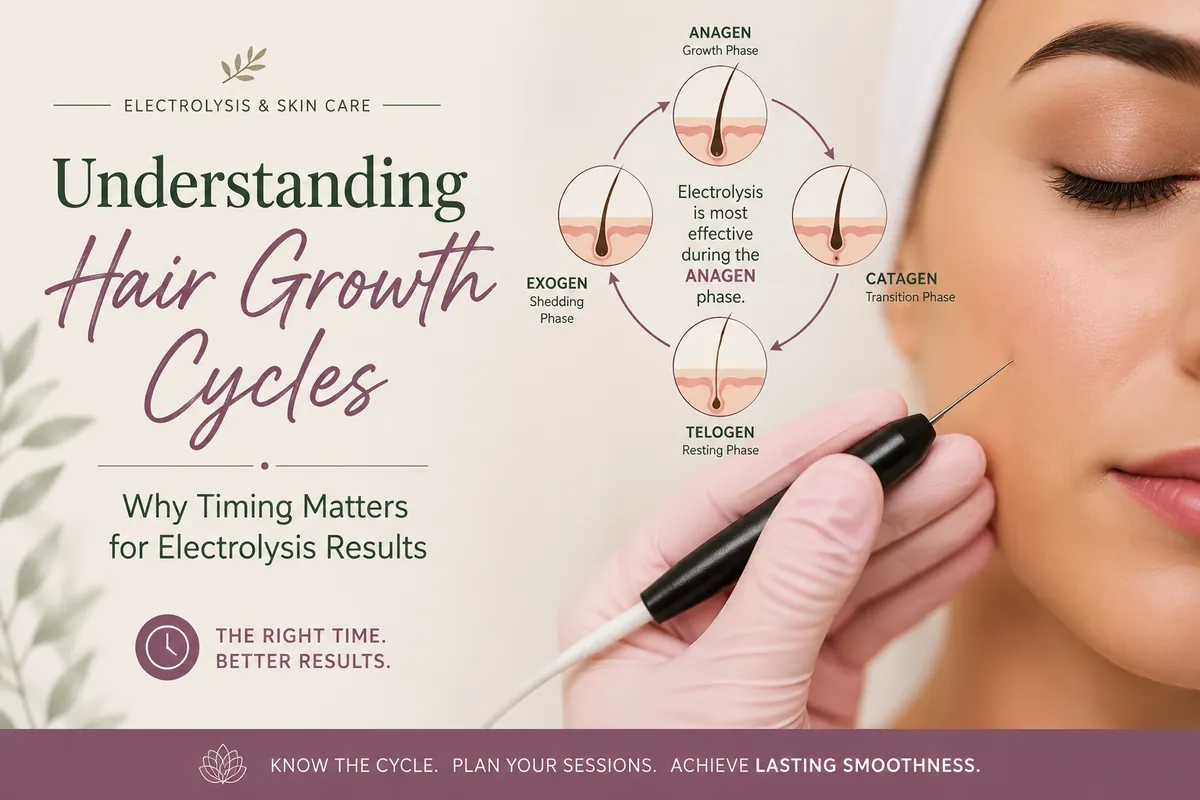
If you have ever wondered why electrolysis takes months, not days, the answer lies in the electrolysis hair growth cycle rather than in technique. Every hair on your body grows on its own independent schedule, and electrolysis only works on a hair when it is in a very specific stage of that cycle. Understanding the electrolysis hair growth cycle is the key to setting realistic expectations for treatment and to understanding why consistency matters so much.
The Stages of Hair Growth
Every hair follicle cycles through distinct phases over its lifetime:
Anagen (the growth phase). This is the active phase, when the follicle is connected to its blood supply through the dermal papilla and is producing new hair cells. The hair is firmly anchored to the root during this stage.
Catagen (the transition phase). A brief stage in which the follicle begins to shrink and detach from its blood supply. The hair is still present and can be treated during this stage, but results are less reliable than in anagen since the follicle is already in the process of disconnecting. This phase generally lasts about two to three weeks.
Telogen (the resting phase). The follicle is dormant and the hair is no longer growing, though the hair shaft often remains visible above the skin until it eventually sheds, sometimes described as a separate exogen, or shedding, phase, before the follicle re-enters anagen and starts the cycle over.
Because every follicle operates independently, hairs on any given area of your body are never all in the same phase at the same time. At any given moment, you have a mix of hairs in anagen, catagen, and telogen sitting side by side, which is part of why no single electrolysis session can ever treat an entire area completely.
Why Anagen Is the Ideal Stage for Electrolysis
Electrolysis works by inserting a fine probe into the natural opening of the follicle and using current to disable the structures responsible for regrowing hair, primarily the dermal papilla and the surrounding matrix cells. During early anagen, the papilla and the stem cell rich bulge are positioned close together near the base of the follicle, which makes it possible to disable the regenerative structures of the follicle in a single, well placed treatment.
In catagen, the follicle is already shrinking and pulling away from its blood supply, so treatment becomes far less reliable. In telogen, the hair shaft is often still visible above the skin, and it can technically be treated, but the follicle is dormant and detached from its blood supply, so there is little to no guarantee that treatment will permanently disable it. In practical terms, this means a hair generally needs to be in active growth, not just visible, for electrolysis to have a strong chance at permanently disabling it.
This is also why electrologists generally advise clients to trim rather than shave between appointments. Hair that is allowed to grow to roughly one to two millimeters above the skin is more likely to still be in the anagen window, while hair that grows out for weeks at a time is more likely to have already cycled into catagen or telogen by the time of the next visit.
How Hair Growth Cycles Differ by Body Area
Not all hair grows on the same timetable, and the differences are significant for treatment planning.
Scalp hair has by far the longest anagen phase, often lasting anywhere from two to six years, which is why scalp hair can grow so long. At any given time, a large majority of scalp follicles, commonly cited around 70 to 90 percent, are sitting in anagen.
Eyebrow hair sits at the opposite end of the spectrum. Only a small percentage of eyebrow follicles, often estimated around 15 to 20 percent, are in anagen at any one time, with the rest resting in catagen or telogen. This is part of why eyebrow hair stays relatively short and why eyebrow areas can take longer to fully clear with electrolysis, since fewer follicles are available to treat at each visit.
Facial hair (upper lip, chin, jawline) generally has an anagen phase of around 4 to 6 weeks for women, with men typically running somewhat longer due to the influence of androgens on facial hair follicles. This relatively short, fast-cycling growth phase, combined with hormonal sensitivity, is part of why facial hair often requires sessions spaced closer together and more total visits than its small surface area might suggest.
Underarm hair cycles faster than scalp hair but still varies by individual. Replacement hairs in this area commonly reappear anywhere from four to ten weeks after a hair sheds, depending on the location and other growth factors.
Leg hair has one of the lower proportions of hair in anagen at any given time, with various sources estimating roughly 20 percent of leg hair in active growth at once, leaving the rest resting. This is part of why larger areas like the legs and back tend to require more total sessions over a longer span of time.
The takeaway is that the percentage of follicles in anagen at any given moment, and the length of that anagen window, varies quite a bit depending on the body area being treated, and your electrologist should be working in different rhythms to account for that.
Average Treatment Timeframes
Because only a fraction of hairs are in anagen on any given day, no single visit can treat everything in an area at once. Multiple sessions are needed to “catch” each follicle as it cycles back into its active growth phase.
General industry estimates for total treatment duration tend to look like this:
- Small areas (upper lip, chin, eyebrows): roughly 8 to 12+ months
- Medium areas (underarms): roughly 9 to 15+ months
- Large areas (legs, back): roughly 15 to 24+ months
Taken together, most clients can expect a full course of treatment in a given area to span somewhere in the range of 12 to 24 months, with visits spaced weeks apart so that newly emerging anagen hairs can be caught as they appear. Missing appointments or stretching the time between them too far allows hairs to cycle past anagen untreated, which can extend the overall timeline.
It is also worth noting that hormonal factors, including conditions like PMOS, thyroid changes, or other endocrine shifts, can activate previously dormant follicles months or even years after a course of treatment is otherwise complete. This is not regrowth from already treated follicles, but rather new growth from follicles that were dormant during earlier visits. This is one of the reasons electrolysis is described as a permanent solution per treated follicle, even though some clients may need occasional touch up sessions if their hormonal landscape shifts over time.
Ready to Start Your Electrolysis Journey?
Now that you understand how the hair growth cycle affects treatment timing, you may be wondering what this looks like for your specific area of concern. Each part of the body follows its own rhythm, and the right session frequency depends on where you’re being treated.
If you’re dealing with facial hair growth, sessions are typically spaced closer together to keep pace with the shorter anagen window. For underarm hair removal, slightly longer intervals between visits allow more follicles to cycle into anagen between appointments. And for larger areas like legs and back, a longer overall timeline reflects both the surface area and the lower percentage of hair in active growth at any given time.
If hormonal factors like PMOS or thyroid changes are part of your hair growth story, you may also find our post on hormonal hair growth and electrolysis helpful for understanding why some areas take longer to clear.
Ready to find out what a personalized treatment timeline looks like for you? Schedule a consultation and we’ll walk through your specific goals, areas of concern, and a realistic plan together.
The Bottom Line
Electrolysis success is governed by biology as much as by technique. Because anagen is the only phase in which a follicle can reliably be disabled, and because the proportion of hair in anagen varies by body area, consistent and properly spaced sessions are what allow an electrologist to gradually catch every follicle at the right moment in its cycle. Patience and consistency are not just good advice. They are a direct reflection of how hair actually grows.
Sources
- Like Velvet Electrolysis. “Electrolysis Hair Growth Cycle.” https://www.likevelvetelectrolysis.com/zapnings/blog-post-title-one-wfpwt
- Emancipated Electrolysis, LLC. “Hair Growth Cycles.” http://www.emancipatedelectrolysis.com/2014/11/17/hair-growth-cycles/
- Hairless NYC Electrolysis Clinic. “Hair Growth Cycles and Treatment.” https://www.hairlessnyc.com/hair-growth-cycles-and-treatment/
- Dorset Street Dermatology. “Hair Growth Cycles.” https://www.dorsetstreetdermatology.com/contents/hair-growth-cycles
- Nios Skin Lab. “Why Electrolysis Needs Multiple Sessions, the Hair Cycle Explained.” https://niosspa.com/blog/post/understanding-the-hair-growth-cycle
- Mike Murphy Blog. “The Hair Growth Cycle and Laser/IPL Treatments, When Is the Best Time to Treat?” https://mikemurphyblog.com/2020/10/15/the-hair-growth-cycle-laser-ipl-treatments-when-is-the-best-time-to-treat/
- Richards & McKoy, “Electrolysis: Observations from 13 years and 140,000 hours of experience,” Journal of the American Academy of Dermatology, 1995 — classic clinical paper on technique, blend method, and the anagen-shaving recommendation: https://www.jaad.org/article/0190-9622(95)91290-8/abstract
- “Electrolysis and thermolysis for permanent hair removal,” JAAD, 1985 — historical/clinical review covering pathophysiology of regrowth: https://www.jaad.org/article/S0190-9622(85)70062-X/abstract
- “Permanent removal of unwanted hair” (galvanic current study), PubMed: https://pubmed.ncbi.nlm.nih.gov/19336191/
Note: This post draws on industry and clinical sources for general education purposes. Individual results vary by hair density, hormonal factors, and treatment consistency. This content is not a substitute for a personalized consultation.